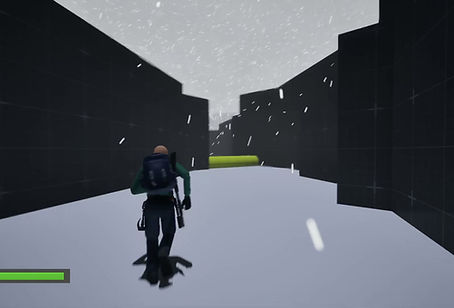
Genre: Horror & Psychology
Type: Blockout
Engine: Unreal Engine 5.6
Tools: UE Blueprints, PureRef
Iterations: 3
Playtests: 1
Role: Level Designer
Description: Design of a linear level focusing on stealth and horror sequences
Introduction
You wake up alone in an abandoned hospital. Darkness reigns, the silence is heavy, and every footstep echoes in the icy corridors. No memories, no landmarks. Why are you here? Who are you really?
As you explore the premises, the answers will gradually emerge... if you dare to go all the way.
Project Details
-
Project Duration: 2 weeks
-
Responsibilities: Level Design
-
Playthrough: ~ 10 minutes
Overview
“The Wake” is a first-person narrative horror level set in a nightmarish hospital, where the player explores an unsettling environment to uncover what happened to them.
I was responsible for the level design and implementation, focusing on pacing, player guidance, and atmosphere.
The goal was to create a psychologically tense experience that subtly guides the player while ultimately subverting their expectations through a final choice.
What I worked on
Layout
-
Designed a tense and oppressive experience, using pacing, lighting, and spatial layout to create constant player discomfort
-
Created a deteriorated hospital environment, emphasizing disorientation and unease through environmental storytelling and navigation
Scripting
-
Developed a dialogue system in Unreal Engine Blueprints to support narrative delivery
-
Implemented a simple AI behavior to reinforce tension and guide player attention
-
Built a dynamic flashlight system, used as a core tool for navigation and atmosphere
Pacing
-
Designed a pacing structure alternating between stealth-driven exploration and narrative delivery, maintaining player engagement while controlling tension levels
-
Leveraged contrast between calm and stressful moments to enhance psychological impact and build anticipation
Implementation
-
Used dynamic audio (music and ambience) to guide player emotions and reinforce key moments in the experience
-
Introduced a hostile entity (monster) to create sustained pressure and influence player movement and decision-making
References
I drew inspiration from the hospital in The Evil Within 2 and the asylum in Outlast, analyzing how both games use level layout, lighting, and sound design to create tension and guide the player through unsettling environments.

Blockout Workflow
How I Blockout
-
Defined the playable space and scale to frame the player experience and control traversal
-
Designed the critical path to guide progression while maintaining clarity and engagement
-
Developed a blockout focused on readability, flow, and player orientation
-
Used landmarks and visual cues to naturally guide the player without explicit UI
-
Established the intended intensity and gameplay pillars (stealth, exploration, tension) early in production
-
Refined mood and player perception through lighting and environmental details
-
Continuously iterated through playtesting, adjusting pacing, difficulty, and spatial design


Level Breakdown
1 - The player wakes up on the fourth floor of an abandoned hospital, creating a sense of confusion and vulnerability.
👉 Goal: atmosphere & cautious exploration
2 - The player reaches the third floor and encounters a mysterious guiding entity.
👉 Goal: narrative hook & player guidance
3 - The level shifts into stealth and infiltration, with hostile entities and limited vision through a flashlight.
👉 Goal: tension & controlled pacing
4 - The player uncovers key elements of their past, shifting from tension to understanding.
👉 Goal: narrative payoff
5 - The level ends with a choice between life and death, designed to subvert player expectations.
👉 Goal: player manipulation & thematic impact

Level Walkthrough
1. The Wake
Introducing the character to the world.

3. Talk With the Entity
Throughout the level, an entity speaks to the player, guides him, and scares him.

5. Stay hidden
Find the continuation via the green exit signs.

7. The Choice
Make a choice between the 2 possible endings of the level.

2. Open The Path
Introduction of the basic mechanics (crouch, flashlight).

4. Encounter with Monsters
Stay discreet and navigate through the darkness.

6. The events
Discover events as they unfold in front of the player.

Level Design Techniques
Lighting
I used lighting to subtly guide the player through corridors while enhancing the oppressive atmosphere.
.png)
Enemy
Monsters are felt more than seen, creating fear through presence and unpredictability.

Stealth
Stealth relies on vulnerability, forcing players to move carefully and stay alert.

NPC
A single mysterious NPC offers guidance and hints at the player's identity.

Choice
The final decision gives emotional weight and meaning to the player’s journey.

Closing Thought
The Wake gave me the opportunity to dive deeper into narrative-driven level design, building a space where the player’s emotional progression mirrors their physical descent. Designing within the closed environment of an abandoned hospital challenged me to use lighting, sound, and layout to create tension and a constant feeling of unease.
I learned how to pace a level by combining different gameplay moments, exploration, stealth, and narrative interactions, while maintaining a consistent tone and dramatic progression. Integrating dialogue moments with a mysterious entity also taught me how to balance storytelling with gameplay flow.
Finally, this project helped me understand how space can carry meaning. Each floor represents a different stage in the character’s journey of self-discovery, and designing around that symbolism pushed me to think more deeply about how level structure can support emotional storytelling.